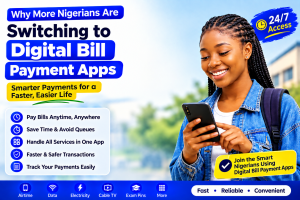
Why More Nigerians Are Switching to Digital Bill Payment Apps in 2026
Paying for everyday services in Nigeria is becoming increasingly digital. Instead of visiting a physical agent or relying entirely on traditional payment methods, more people now use smartphones to buy airtime, purchase data, pay electricity bills, renew cable TV subscriptions, and handle other everyday payments.
This shift is part of a broader change in Nigeria’s payment ecosystem. The Central Bank of Nigeria (CBN) reported strong growth in electronic payment channels, with mobile payment transaction volume increasing by 19% and value increasing by 30% in the first half of 2024.
Digital bill payment apps are helping make these everyday transactions more convenient. With the right app, users can access several services from one place without having to visit different websites, banks, or physical agents.
What Are Digital Bill Payment Apps?
Digital bill payment apps are mobile applications that allow users to pay for different services electronically.
Depending on the platform, you may be able to:
- Buy airtime
- Purchase mobile data
- Pay electricity bills
- Subscribe to DStv and GOtv
- Pay Startimes subscriptions
- Purchase examination pins
- Make other digital payments
Instead of handling each service separately, users can manage several everyday transactions from a single application.
1. Convenience Is a Major Reason
One of the biggest reasons Nigerians are moving toward digital bill payment apps is convenience.
Imagine needing to renew your cable subscription, purchase data, and buy electricity tokens. Traditionally, you might have to deal with different agents or payment channels for each service.
With a digital payment app, you can complete these transactions from your smartphone.
You don’t necessarily have to:
- Leave your home
- Search for an available agent
- Join a queue
- Carry cash
- Visit multiple locations
Everything can be handled from one device.
2. Payments Can Be Made Anytime
Physical payment outlets have opening and closing hours. Digital apps, however, can allow customers to make transactions at any time.
This becomes particularly useful when you need to make an urgent payment late at night or early in the morning.
For example, if your data finishes while you’re working at night, you can purchase another bundle directly through your phone instead of waiting until the following day.
The same convenience can apply to other digital services supported by the platform.
3. Nigerians Are Becoming More Comfortable With Digital Payments
The growth of electronic payments is not happening by accident. Nigeria’s payment infrastructure has continued to develop, while regulators have also encouraged safer and more efficient electronic payment systems.
The CBN’s Payments System Vision 2028 places emphasis on security, inclusion, innovation, interoperability, trust, and collaboration, showing the continued focus on developing Nigeria’s digital payment ecosystem.
The CBN also describes Nigeria’s instant payment infrastructure as one of the country’s major financial technology strengths. Its 2026 fintech report says nearly 11 billion electronic transactions were processed in 2024.
4. One App Can Handle Multiple Bills
Another advantage is the ability to manage different services from one application.
Rather than having separate apps for every type of payment, many digital bill payment platforms combine several services.
A typical app may allow you to purchase:
- Airtime
- Data
- Electricity tokens
- Cable TV subscriptions
- Examination pins
Some platforms go even further by offering additional digital financial services.
This makes the smartphone a convenient place for managing everyday payments.
5. Faster Transactions
Speed is another important factor.
When people are paying for essential services, they generally don’t want to wait unnecessarily for their transaction to be completed.
For instance, someone buying an electricity token may need the token immediately. Similarly, a customer purchasing data may need internet access immediately after completing payment.
This has increased the demand for platforms that can process transactions quickly and provide instant confirmation.
6. Reduced Dependence on Cash
Digital payment apps also reduce the need to carry physical cash for everyday transactions.
Nigeria has been moving toward a more electronic payment environment for years. The CBN’s payment strategy specifically identifies electronic bill payments, mobile top-ups, mobile payments, and instant payments as important parts of the country’s transition away from cash.
This doesn’t mean cash has disappeared. Rather, Nigerians now have more options for completing transactions without physically handling money.
7. Easier Access to Airtime and Data
Airtime and data are among the most frequently purchased digital services in Nigeria.
People need data for:
- Social media
- Online classes
- Remote work
- Streaming
- Online businesses
- Banking
- Communication
Digital bill payment apps make it possible to purchase these services directly from a phone without searching for a physical vendor.
For businesses and individuals who purchase data regularly, this can save considerable time.
8. Better Transaction Records
Another useful feature of digital payment apps is transaction history.
Instead of relying on memory or physical receipts, users can often view previous transactions directly within their account.
This can help you keep track of:
- How much you spend on data
- Previous electricity payments
- Cable subscription dates
- Airtime purchases
- Successful and failed transactions
For people running businesses, transaction records can also make financial management easier.
9. Digital Apps Can Be Useful for Businesses
The benefits aren’t limited to individual consumers.
Small businesses, retailers, students, freelancers, and VTU operators can also use digital payment platforms to manage their everyday transactions.
For example, a small business owner may need to purchase data for business communication, pay electricity bills, or renew internet and cable subscriptions.
Instead of handling each transaction separately, a multi-service payment platform can simplify the process.
10. Competition Is Improving the User Experience
The growing digital payment market has also encouraged platforms to compete on convenience, speed, pricing, and features.
Newer platforms are entering the market with services designed to address common frustrations such as failed transactions and payment delays. For example, SnappyPay launched in Nigeria with services covering electricity, airtime, data, cable TV, and other digital transactions.
This competition can benefit consumers because platforms have more reason to improve their applications and services.
What Should You Look for in a Bill Payment App?
Not every digital payment app will provide the same experience. Before choosing one, consider the following:
- Transaction reliability: Check whether payments are processed successfully.
- Speed: Look for platforms that deliver services quickly.
- Available services: Choose an app that supports the bills you regularly pay.
- Security: Protect your account and payment information.
- Customer support: Make sure help is available when something goes wrong.
- Transaction history: A clear record of payments is useful.
- Pricing: Compare service prices and applicable charges.
It is also wise to research the company behind an app and verify that it operates within the relevant regulatory framework where applicable.
Are Digital Bill Payment Apps Safe?
Digital payments can be convenient, but users should still take security seriously.
Before using an unfamiliar application, check its reputation and avoid downloading apps from suspicious sources.
You should also:
- Use a strong password
- Keep your phone secured
- Never share your PIN or password
- Avoid clicking suspicious payment links
- Confirm transaction details before paying
- Keep your payment applications updated
The CBN’s current payment-system strategy places strong emphasis on security and consumer protection, reflecting the importance of trust as digital payments continue to grow.
The Future of Bill Payments in Nigeria
The shift toward digital payments is likely to continue as smartphones, internet access, fintech services, and electronic payment infrastructure become more integrated into everyday life.
The CBN’s Payments System Vision 2028 specifically aims to build a secure, inclusive, innovative, and interoperable payment ecosystem.
This means consumers can expect continued development in areas such as mobile payments, digital wallets, instant payments, bill payments, and other financial technology services.
Final Thoughts
More Nigerians are switching to digital bill payment apps because they offer something that traditional payment methods often struggle to provide: convenience, speed, accessibility, and multiple services in one place.
From buying data and airtime to paying electricity and renewing cable subscriptions, smartphones are becoming an increasingly important tool for managing everyday payments.
However, convenience should not come at the expense of security. Before choosing an app, compare its services, reliability, pricing, security features, and customer support.
As Nigeria’s digital payment ecosystem continues to develop, bill payment apps are likely to become an even bigger part of how Nigerians handle everyday transactions.